GMO vs GEO vs Hybrid vs Heirloom
Sorting Out the Facts (Without the Drama)
Walk through any garden center in spring and you’ll hear it:
“Are these GMO?”
“I only grow heirlooms.”
“Hybrids aren’t natural, right?”
Tomatoes seem to sit at the center of the confusion. Labels get confusing, terms get stretched, and myths take on a life of their own. Let’s slow things down and look at what these terms actually mean, using tomatoes as our example — without drifting into moral or ethical debates.
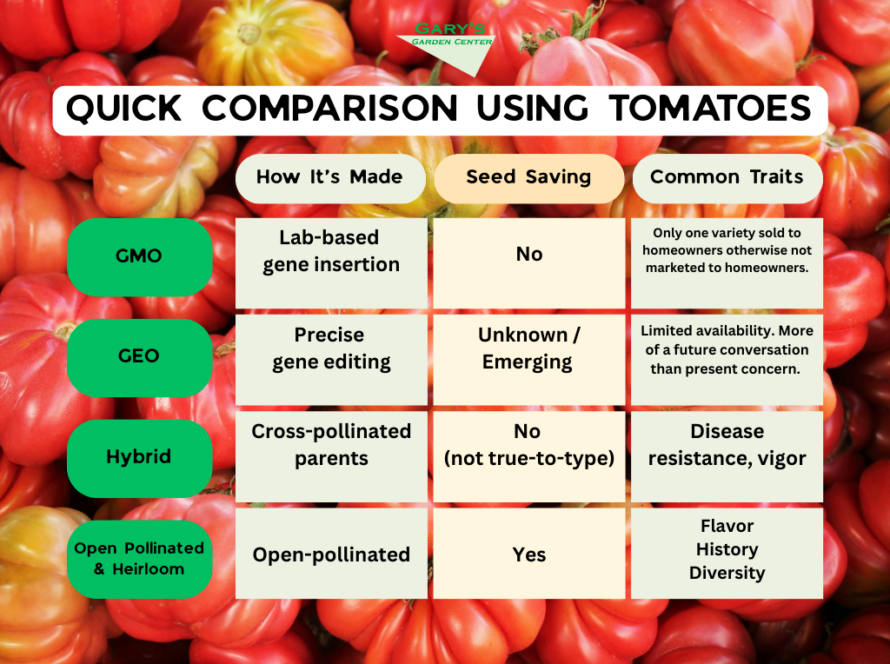
First and Foremost: Gary’s Garden Center does not sell GMO vegetables or fruits.
ALL Tomatoes for Home Gardens Are Non‑GMO with One Exception.
What Does GMO Actually Mean?
GMO stands for Genetically Modified Organism, but in gardening terms it refers to a very specific type of genetic engineering.
A plant is considered a GMO when:
- Its DNA is altered in a laboratory, and
- Genetic material from another species is inserted into the plant’s genome
This is different from:
- Hybridization, which crosses plants of the same species through controlled pollination
- Open-pollinated or heirloom varieties, which reproduce naturally and grow true from seed
Only when genes from an unrelated organism are added does a plant meet the traditional GMO definition.
The Exception:
For many years, this statement was completely accurate: There were no GMO tomatoes sold to home gardeners.
That is almost still true today—with one very specific exception.
The Purple Tomato™ (Please, do not confuse this with heirloom varieties such as Cherokee Purple or Black Prince among others.)
A GMO tomato has been approved and marketed to home gardeners: The Purple Tomato™ developed by Norfolk Plant Sciences.
- It was created by adding genes from snapdragon flowers to a tomato plant
- Those genes enable the tomato to produce anthocyanins (antioxidants), the same pigments that make blueberries and purple cabbage purple
- Because DNA from another species was inserted, this tomato is considered GMO
This purple tomato is:
- The only GMO tomato currently marketed to home gardeners in the United States
- Still very limited in availability compared to standard garden tomatoes
Outside of this single, well‑publicized variety:
All other tomato plants and seeds commonly sold in garden centers are non‑GMO.
GEO (Genetically Edited Organisms): A Newer Term You May Hear
GEOs use newer technology (like CRISPR) to make very precise edits to a plant’s existing genes—often changes that could occur naturally over time.
Key points:
- No foreign DNA is added
- Changes are highly targeted
- GEO crops are still very limited in availability
At this time, GEO tomatoes are not common in retail garden centers.
If you’re shopping locally for tomato plants, GEOs are more of a future conversation than a present concern.
Which brings us to the terms that do apply to the vast majority of tomatoes gardeners grow.
Hybrid Tomatoes: Cross-Pollinated on Purpose
Hybrid tomatoes are created by crossing two specific parent plants to combine their strengths.
This is done through controlled pollination, not lab-based genetic modification.
Common reasons breeders create hybrids:
- Improved disease resistance
- Higher yields
- More uniform fruit size
- Better heat or cold tolerance
Examples you may recognize:
- ‘Better Boy’
- ‘Early Girl’
- ‘Celebrity’
A common misconception
“Hybrids are unnatural or genetically modified.”
They’re not. Hybridization is simply selective breeding, the same process farmers and gardeners have used for thousands of years—just more intentional.
One thing to know: seeds saved from hybrid tomatoes won’t reliably grow true to the parent plant. That’s a gardening consideration, not a quality issue.
Heirloom Tomatoes: Open-Pollinated with History
Heirloom tomatoes are a type of open-pollinated tomato, meaning they will grow true from saved seed.
The definition of heirloom can vary some depending on who you talk to but generally, a tomato is considered heirloom if:
- It has been passed down for multiple generations (often 50+ years)
- It is open-pollinated
- It has a stable genetic line (seed can be saved)
Popular heirlooms include:
- ‘Brandywine’
- ‘Cherokee Purple’
- ‘Mortgage Lifter’
What heirlooms are known for
- Exceptional flavor
- Unique colors and shapes
- A strong connection to gardening history
What they’re not guaranteed to be
- Disease resistant
- High yielding
- Uniform
Heirlooms aren’t better or worse—they’re simply different, and often a bit more demanding in the garden.
Open-Pollinated (Not All Are Heirlooms)
It’s worth noting:
Not all open-pollinated tomatoes are heirlooms.
Some are modern varieties bred more recently but still stable and seed-saving friendly. These often offer a nice middle ground:
- Reliable performance
- Consistent results
- Ability to save seed
A Quick Look Beyond Tomatoes
The same breeding terms apply across the vegetable and fruit crops you’ll find in the garden center. Here’s how they play out in a few popular favorites:
Peppers
- Almost entirely hybrid or open-pollinated, not GMO
- Heirloom peppers are valued for flavor, heat variation, and unique shapes
- Hybrids offer better yields, thicker walls, and improved disease resistance
- No GMO peppers commercially available or approved for sale in the U.S.
Cucumbers
- Commonly sold as hybrids for uniform shape, productivity, and disease resistance
- Open-pollinated cucumbers remain popular for slicing and pickling
- No GMO cucumbers commercially available or approved for sale in the U.S.
Squash (Summer & Winter)
- Widely available as hybrids to improve plant vigor and resistance to squash diseases
- Many classic open-pollinated varieties are still grown and seed-saved
- No GMO squash varieties are marketed for home gardens.
Cantaloupe (Muskmelon)
- Predominantly hybrid for sweetness, uniform ripening, and disease resistance
- Open-pollinated varieties exist and are often favored for traditional flavor
- No GMO cantaloupe commercially available or approved for sale in the U.S.
Watermelon
- Mostly hybrid, including seedless varieties (which are sterile hybrids, not GMO)
- Open-pollinated watermelons are available for seed saving
- No GMO watermelon commercially available or approved for sale in the U.S.
Strawberries
- Almost all garden strawberries are hybrids, selected for fruit size, yield, and disease resistance. A few heirloom varieties are still available.
- Strawberries are propagated by runners rather than seed
- No GMO strawberries commercially available or approved for sale in the U.S.
Across these crops, the pattern stays consistent:
Home gardeners grow hybrids and open-pollinated varieties, while GMOs—if they exist at all—are rare, clearly labeled, and generally not part of the retail garden center world.
Curious what commercially grown crops are actually bioengineered? Given of the GMO hysteria, you may be surprised how short the list actually is! Here’s a link to the USDA’s list: click here.
Final Thoughts
There’s a lot of noise around GMO, but when we stick to the facts, things get simpler. GMO concerns are practically non-existent at retail garden centers for the home gardener across all vegetable crops!
If you ever have questions about what you’re growing—or what a label really means—we’re always happy to help you choose the right plant for your garden.
Because in the end, the goal is the same:
A healthy plant, a good harvest, and homegrown goodness that beats store bought every time! 🍅